
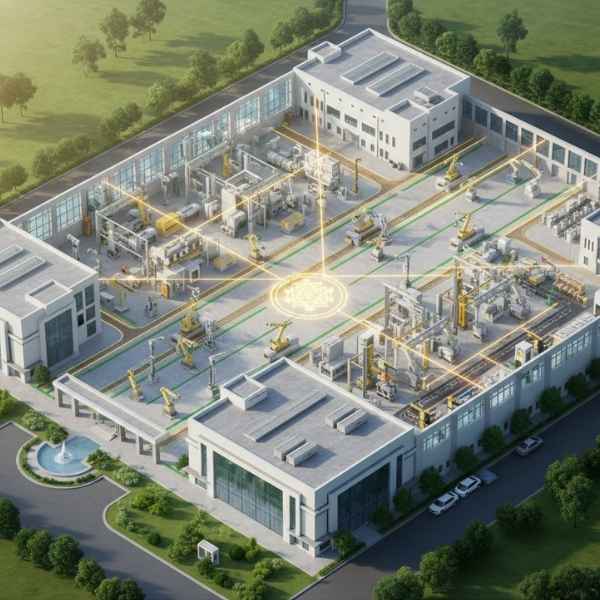
In the industrial sector, the margin for error is razor-thin. Industrial Vastu is a specialized architectural science that aligns large-scale manufacturing units, warehouses, and factories with the natural forces of the universe. Unlike residential Vastu, which focuses on comfort, Industrial Vastu is strictly designed for uninterrupted production, machine longevity, and labor harmony. When a factory is built according to Vastu principles, it functions as a synchronized machine, minimizing breakdowns and maximizing output.
The Human & Machine Synergy
Industrial Vastu also addresses the “soft” side of manufacturing. By placing labor quarters in the appropriate zones and ensuring the Northeast is clear for mental clarity, companies can significantly reduce labor strikes, accidents, and technical glitches.
By implementing Industrial Vastu, you are not just following a tradition; you are performing Spatial Engineering. You are ensuring that every kilowatt of power and every man-hour spent contributes to a more profitable, stable, and scalable industrial empire.
Heavy machinery and raw material storage should be concentrated here. This provides the necessary “grounding” for the structure, preventing structural damage and ensuring the stability of the finished goods.
These areas should be kept light and open for finished goods and administrative offices. This encourages a smooth exit of products to the market and a healthy influx of new orders.
School of Cosmic Wisdom, Universal Sympathy, transcendental philosophy, empirical science.The universe as a living tapestry rather than a mechanical machine.
Industrial Vastu is a high-level spatial science specifically designed to manage the intense energies of manufacturing units, factories, and warehouses. Unlike residential Vastu, it focuses on the heavy-duty balance of mechanical heat, massive weight, and rapid material flow. By aligning your industrial facility with the Earth’s magnetic grid, you ensure that every machine operates at maximum efficiency and every man-hour translates into profitable output.
We focus on the Southeast zone (Agni) for the placement of boilers, furnaces, transformers, and generators. Proper alignment in this sector prevents technical breakdowns and fire hazards while ensuring a continuous "spark" in production cycles.
A key highlight is the concentration of massive loads in the South and West zones. Placing heavy manufacturing units and bulk raw materials here provides the necessary structural "gravitas," which reduces machine vibration and enhances the longevity of your equipment.
We design the factory layout to follow a clockwise, "Pradakshina" movement—ensuring raw materials enter through specific auspicious zones and finished goods exit toward the North or Northwest.
By clearing the Northeast zone for water storage or meditation spaces and positioning administrative blocks in the North or East